February, 2012
March Celebration of Birds
Join us on March 24 and 25th for a celebration of our local birds and those who work closely with them. Tucson area wild life rehabilitators will be on hand with “educational” animals (birds that cannot be released back into the wild); expert biologists will offer short presentations about their specific interest, like bats, birds, habitats, etc.
Last August we had a weekend-long event in the store to celebrate Tucson’s wildlife rehabilitation groups and birding in the Tucson area. Several representatives from three major rehab organizations attended to explain the unique and extraordinary the work they do. Each group brought rehabbed birds that, for a variety of reasons, cannot ever be released back into the wild. We had owls, hawks and hummingbirds in the store for folks to appreciate close up. The feedback we got from that event was amazing. Folks really enjoyed their time here learning about and seeing these wonderful birds. Sandy Wolf spoke about her work with our nectar eating bats. We also featured a book signing by world renowned author and bird guide Rick Taylor, demonstrations by our Tucson artists and artisans whose work we feature in the store and representatives of Tohono Chul Park and Agua Caliente Park were on hand to answer questions. We had many, many requests to do a similar event again. So, we are planning such an event for this coming March.
It’s still too early to dependably give you all the details, but the list of participants and the schedule of events will be published in the March newsletter. The weekend that works best for the majority of the presenters is the 24th and 25th of March, a Saturday and Sunday. We’re giving you a heads up now so that there is enough time to plan on attending.
Happy Birding!!!
Jon, Shani and Clarisa
We are excited to announce that we are starting to shoot some simple informative birding videos that appear on YouTube and our website. You can subscribe (for free) to see them when new ones appear by going to The Wild Bird Store YouTube Channel. We hope to offer many topics and hopefully go on location to Tucson area birding hotspots. Please submit your comments, questions or ideas.
Join us, won't you?
On October 11, 2011 I was invited to do an interview on “the Jolt”, AM 1330. The show Ron Asta’s Tucson gave us a digital recording of the interview. The show runs about 36:36 minutes long. We didn’t get through all the talking points we wanted to so I’ve been asked to return for a second interview sometime in the near future. We’ll keep you posted. We did have a great conversation about the nectar eating bats that are unique to our area and a little about birding. The next conversation will focus more on the wonderful birds we experience here.
We present the program below. |
|
|
WE HAVE MOVED
The Wild Bird Store has moved to 3160 East Fort Lowell Road, on the southeast corner of Country Club Blvd. and Ft. Lowell Road – in the Winterhaven Square. After two decades, we are beginning a new chapter in our efforts to aid and educate birding enthusiasts in a...
|
|
THE WILD BIRD STORE
Located in Tucson, Arizona and begun in 1992 as a true mom and pop business, has a strong regional
reputation as an independent wild bird store featuring our line of innovative
and unique wild bird products. Our loyal customer base depends on us for
quality products, expert advice and dedicated customer service. 
|
|
|

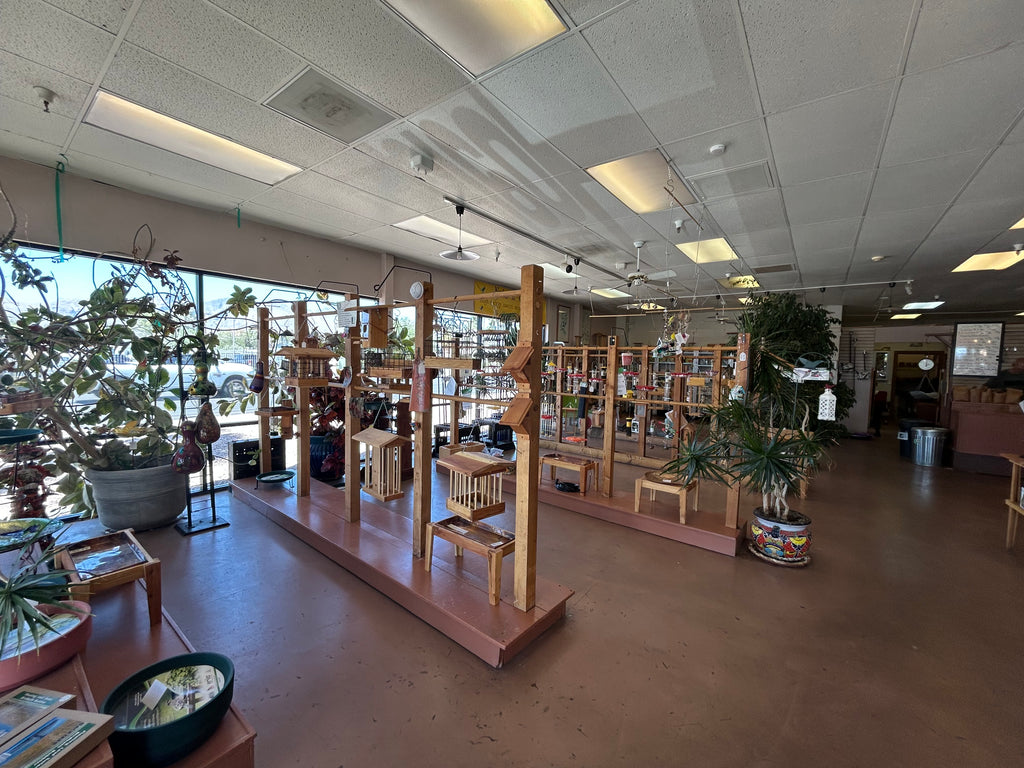
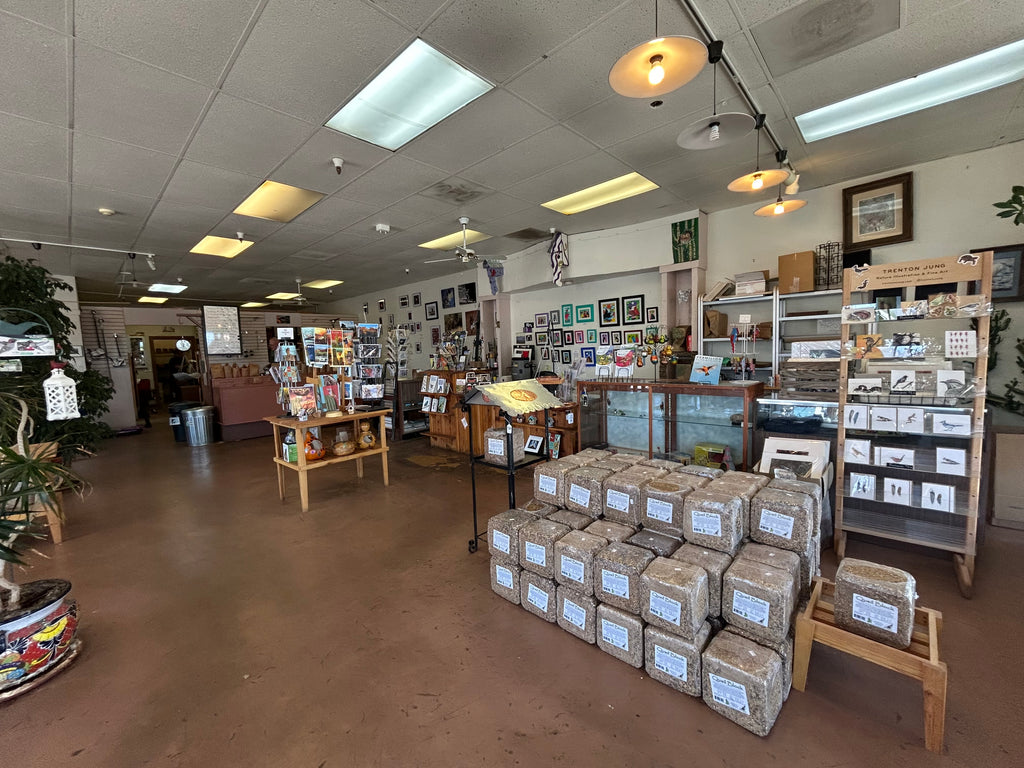
Want to see a panorama of the Wild Bird Store? Click the image to zoom-in or to pan left or right. |
|
CARDINAL
FEEDERS
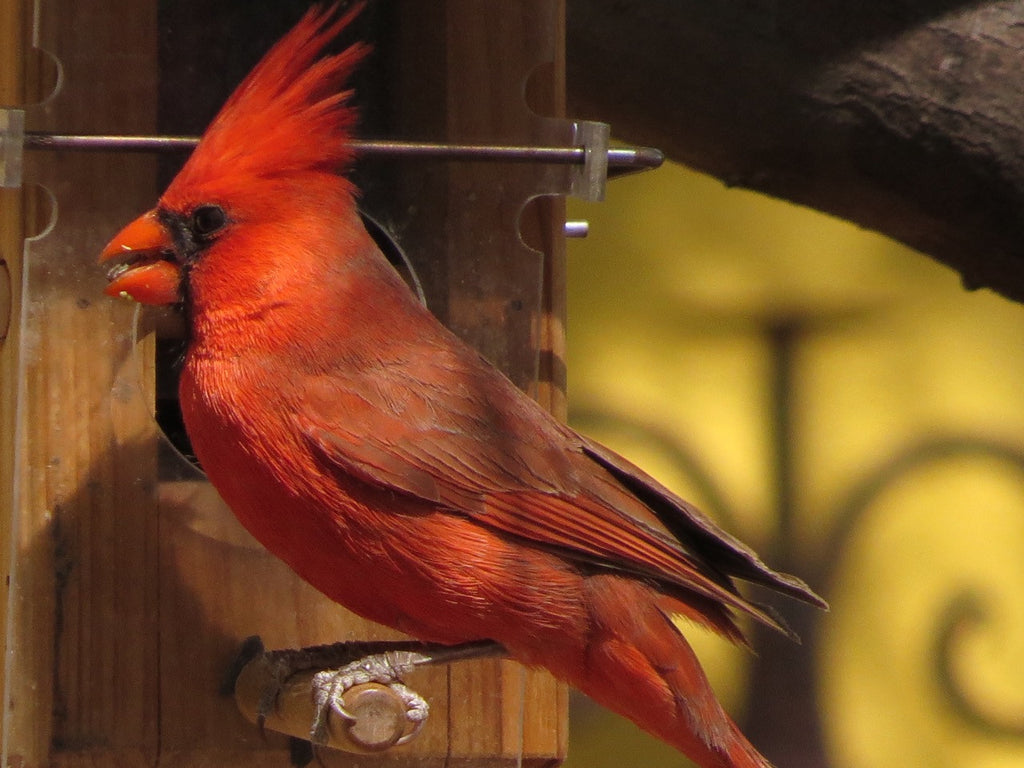
Cardinals
no longer have to wait at the periphery of the yard for the feeding frenzy
to quiet down before coming to the feeder. Now, with this feeder for their exclusive use, they can feed undisturbed from sunrise to
sunset. This weight-activated feeder will accommodate the entire cardinal
family - from fledglings to adults. All other birds both heavier and lighter
than cardinals...
|
|
NUTS 'N' BUGS
If you had to choose just one food for birds, one they would not only
survive on, but actually thrive on, Nuts 'n'
Bugs is it! Created from a recipe of ground pecans and dehydrated
insects (over 1,000 per pound), it has calcium, soybean meal, and rendered
suet to bring in insect and nut eating birds. With Nuts
'n' Bugs you can attract a wide variety of insect eating
birds- many of which are not attracted to seeds. 
|
|
GOLDFINCHES IN SOUTHEAST ARIZONA
|
Photo by Richard at SearchNet Media |
Southeastern Arizona birders have experienced a phenomenal increase in the numbers of goldfinches that can be attracted to our backyard birding stations.
Twenty years ago and more, it took us months to attract our first goldfinches. Patience, we reminded ourselves as we did our customers, is the number one rule for birders.
The preferred food for the intended species and the right feeder to deliver that food is number two. Understanding these principles will always reward us and the birds.
Nyjer seed, unlike true thistle, is the preferred choice of seed for all the goldfinch species. Most other species in our area will reject Nyjer for almost any other seed that is easily available and accessible. Almost any design of thistle feeder filled with Nyjer seed will attract mostly goldfinches. The feeder models that have food ports under the perches are species specific to goldfinches.  |
|
BIRDS, WATER AND SUMMER HEAT
|
Cooper's Hawk by Richard at SearchNetMedia |
In our desert heat, we are stating the obvious - birds need clean reliable water sources all year round, but no more than when the temperature soars. As we write this, the projected heat for this afternoon is 113°F, and likely to remain in the triple digits for the rest of the week. As the drought deepens in southern Arizona, natural water sources continue to dry up. Our record setting fire season has taken its toll on the wildlife. Birds pant and hold their wings out from their bodies in an attempt to keep cool. Supplying a water source for the birds is of great assistance to them and the necessity of clean fresh water cannot be underestimated.
Of course, you want to do this in a way that does no harm - no drowning, no disease transmission, no increase in predation, no harm what-so-ever. Here's what you need to know about bird baths and other water features to help the birds, without harming them.  |
|
HOW TO INCREASE BACKYARD DIVERSITY
Photo by Richard at SearchNet Media
 |
With more species of birds than almost any other region in the country, Southeastern Arizona's biodiversity offers backyard birders one of the best opportunities to attract a wide variety of birds.
The combined number of year-round resident and migrating birds that one can see in the cycle of a year's time is greater than most other regions throughout the continent. However, if you don't devote some time on a regular basis to observing, you may miss some of the migrants which only pass through our area and remain only for a relatively short time.
Southeastern Arizona is also an excellent place to notice quite a few rare and exotic species that migrate through or use our area in spring and summer as their traditional breeding territory.
With relatively little effort and expense, you can easily double and triple the number of species attracted to your feeding stations.  |
|
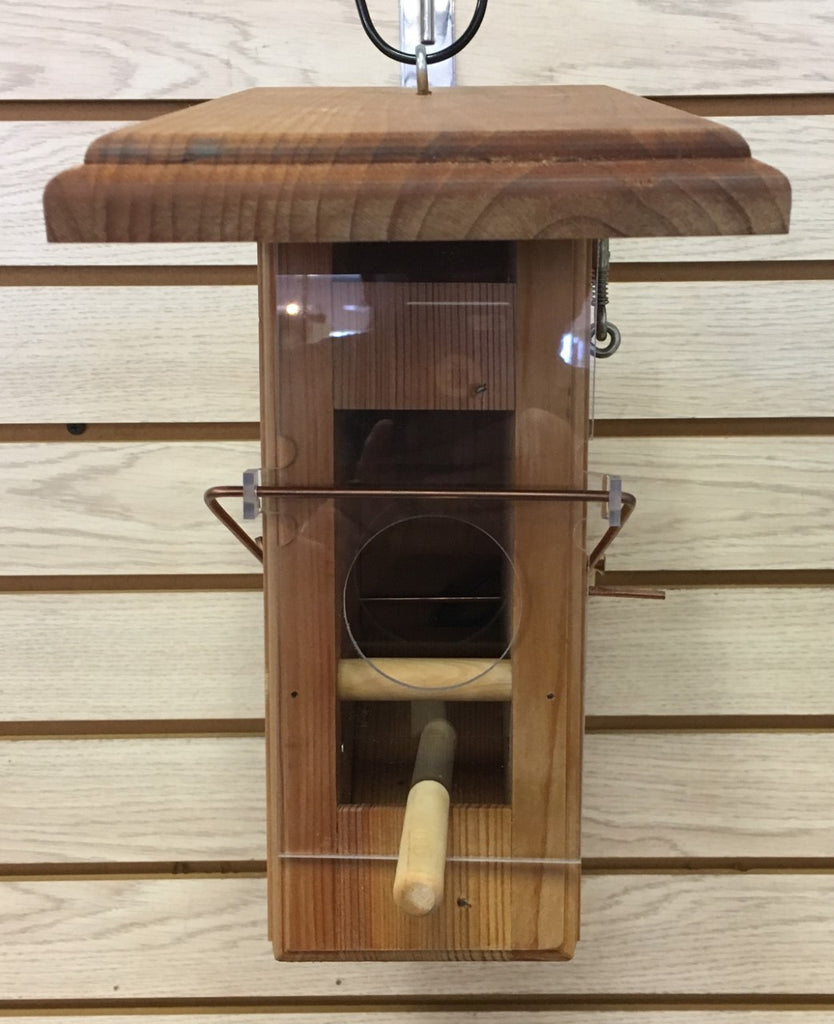
INTRODUCING A NEW CARDINAL FEEDER
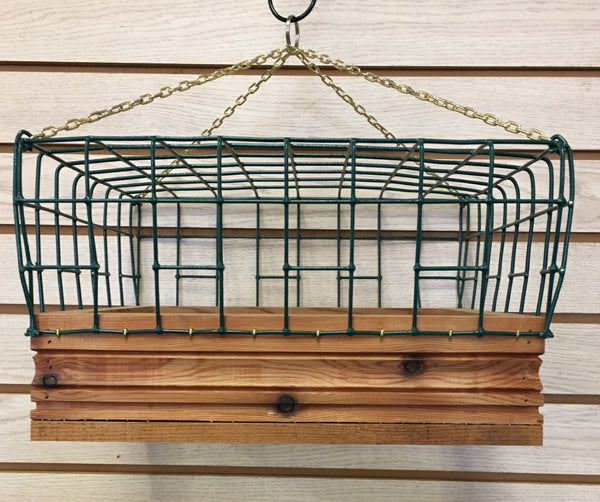
We have become the exclusive authorized dealers in Arizona for a new species-specific cardinal feeder that serves as a less expensive version of the cedar wood model we pioneered about twenty years ago.
This model is constructed of tough polycarbonate material, can be hung or pole mounted, and is manufactured in Montreal, Canada by the Wild Bird Conservation Center. We have received our first shipment and we expect it to sell for around $60. While it was created for a cold, wet northern climate in that it is weather proof (keeps rain and snow out), it works perfectly well in our region as well. (Keeping seeds dry in Arizona isn’t too much of a concern).
So, for customers who wish for a more economical way to give cardinals, pyrrhuloxia and grosbeaks what they want most (our cardinal mix and a little exclusivity) this is the feeder you’ve been waiting for!  |
|
BASIC BINOCULAR KNOWLEDGE
Birders, whether the backyard or in-the-field- variety, need only two essential items as the basic tools for learning about bird identification and behavior - a good field guide and reliable binoculars. The Wild Bird Store carries the best field guide for our area. It is the new Birds of Southeastern Arizona by Richard Taylor and has established itself as our best selling identification guide since its publication late last year. With just these two things, you can teach yourself all you want to know about the birds of our specific region, or anywhere for that matter. 
The Wild Bird Store offers a comprehensive selection of Vortex Binoculars 
|
|
WILD BIRD STORE DISCOUNT CLUB
For almost twenty years we have offered our customers the opportunity of reducing costs on each and every purchase they make. The cost of annual dues is $16.00 ($1.25 per month). Discounts begin on the day a membership is activated and expires one full year from the last day of the month the membership begins.  |
|
HOW TO ATTRACT ORIOLES
 Orioles are not as common or abundant as most of our year round resident birds. Yet, as a migratory species, they are reliably present from early spring to fall. We have had orioles at our station from as early as February until as late as early November.
Orioles (and their relatives, like the tanagers) have beautiful and strikingly colorful plumage, their exquisite and fluid songs, and their parenting and nesting abilities make them very desirable birds to attract and observe. The relatively small effort to attract and feed orioles rewards...  |
|